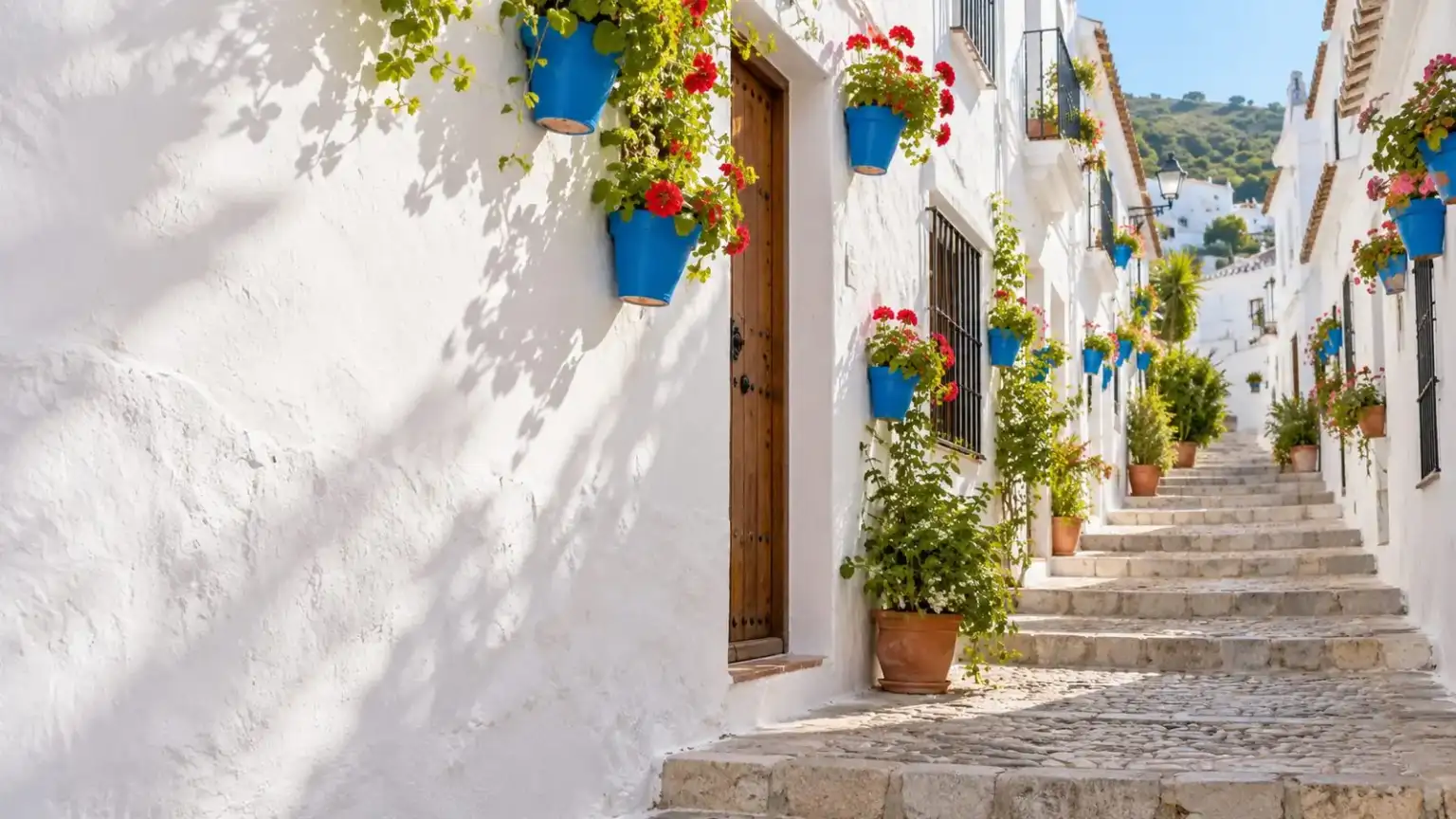
Village house or country house: two different purchases
In the old quarter of Frigiliana, houses often carry decades of history: inheritances that were never registered, floor areas that don’t match, terraces and rooms added over time. On top of that, the planning rules that protect the look of the village can restrict work on façades, roofs or extensions. Before you buy, I check what the municipal planning rules allow, not just what the seller tells you.
In the countryside the order is different:
- The land classification. If the house is on rural land (suelo rústico), what you can do with it depends on when it was built, whether it had a licence and whether it can be recognised as a building with asimilado a fuera de ordenación status (for buildings that do not conform to planning rules but can no longer be subject to enforcement).
- Access. Many houses are reached by tracks that cross other people’s land, and there is not always a written right of way (servidumbre de paso).
- Floor area. What is built, what is recorded in the Registro de la Propiedad (Land Registry) and what appears in the Catastro (the cadastre, Spain’s property survey register) should match. If they don’t, you need to know how to correct it and who bears the cost.
Only once you have those three answers does it make sense to talk about price. Committing earlier, with a deposit already paid, is the most expensive mistake of all.
Living between two countries: wills and inheritance
Many Frigiliana owners spend part of the year in another country, and their assets are spread out too. Since 2015 the European Succession Regulation (Regulation (EU) No 650/2012) has applied. The general rule is that the inheritance is governed by the law of the country where the deceased had their habitual residence. But in your will you can choose the law of your nationality, and that choice makes a big difference: who inherits, what share is reserved for children and how the estate is divided.
A will made before a Spanish notary for the assets located here usually simplifies the inheritance, provided it is consistent with the one you have in your own country and does not revoke it by accident. I review this point carefully, because one badly worded sentence can cancel the earlier will. There is more information in inheritance, succession and gifts.
Residency and holiday lets
If you are a citizen of another European Union country and are going to live in Frigiliana for more than three months, you must register with the Registro Central de Extranjeros (the Central Register of Foreign Nationals) and obtain the EU citizen registration certificate. British nationals no longer follow this scheme since Brexit: those who were living in Spain before 2021 have their own residence document, and those who arrive later follow the general immigration rules. I can help you with the residency application.
To let your house to tourists, the Junta de Andalucía (the regional government) requires it to be entered in its tourism register (Registro de Turismo de Andalucía) and to comply with Decreto 28/2016 on holiday homes. Municipalities can add their own restrictions, so it is worth checking before you invest. I explain it in the article on the Junta de Andalucía requirements for holiday lets.
How I work with you if you are abroad
I do not have an office in Frigiliana. The nearest is in Nerja, at Avenida del Mediterráneo, Edificio Toboso II, local 8, where I see clients by appointment.
If you are outside Spain, you have two options. In writing: you send me your question with the documents and, for €75 including VAT, you receive my reply within 72 working hours at most, sometimes within 12. By video call: 30 minutes for €75, with your file already studied. At the end I give you the conclusions and next steps in writing, so you can decide calmly wherever you are.